Nearshore used to be sold mainly as “cheaper, but close by”. That argument is getting weaker. Wages in Central and Eastern Europe are rising quickly, and the better reasons to choose the region today have more to do with languages, working hours and regulation.

We have delivered customer service from Romania since 2004, so we are not neutral on this. We do have delivery centres outside Europe as well, and we would rather tell you when nearshore is the wrong fit than win a contract that disappoints you a year later.
Onshore, nearshore or offshore?
The terms depend on where you are. For a company in Germany, the UK or the Netherlands, they usually mean the following.
| Model | Example locations | Typical rate per hour | Main strength | Main trade-off |
|---|---|---|---|---|
| Onshore | Your own country | Often $28 or more | Local market knowledge | Highest cost, tight labour markets |
| Nearshore | Romania, Bulgaria, Poland, Portugal | $12–32 | Languages, shared hours, EU options | Smaller talent pools for very large programmes |
| Offshore | Philippines, South Africa | $8–17 | Lowest rates for English support | Time difference, fewer European languages |
Rates from the rethinkCX BPO Cost Index, May 2026. The onshore figure is the US range, as the index does not list Germany, the UK or Ireland.
Shared working hours are underrated
Time zones sound like a small detail until a live incident happens at 10 am and the people who can fix it are finishing their shift. Shared hours also make training, calibration and quality reviews much easier.
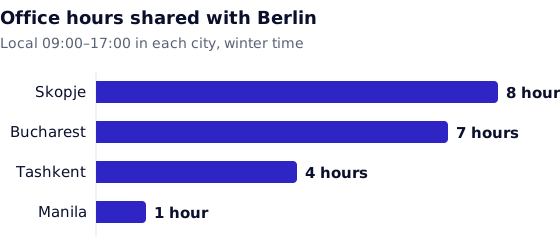
We include Tashkent on purpose: Uzbekistan, which runs on Tashkent time, is home to our newest delivery centre. With only four shared hours, it is not a replacement for a team next door. It works well for different reasons, such as extending coverage and reaching new language skills.
Labour costs: still a gap, but closing
The gap is real. According to Eurostat, hourly labour costs across the whole economy were €13.6 in Romania in 2025, against €34.9 on average in the EU.
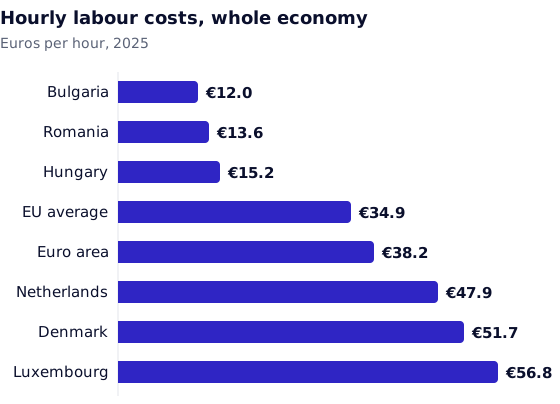
The more interesting number is the speed of change. Labour costs grew by 10.6% in Romania and 13.1% in Bulgaria in 2025, compared with 4.1% across the EU. If saving money is your only reason for moving, that advantage will shrink. A decision built on language skills and service quality holds up better.
Language skills
English is rarely the hard part in this region. The EF English Proficiency Index 2025 gives these scores, which we have placed next to the typical hourly rates from rethinkCX.
| Country | EF English score, 2025 | Typical rate per hour |
|---|---|---|
| Portugal | 612 | $24 |
| Romania | 605 | $17 |
| Poland | 600 | $25 |
| North Macedonia | 595 | Not in the index |
| Bulgaria | 594 | $18 |
| Hungary | 590 | Not in the index |
The harder question is where you will find a Finnish or Slovenian speaker who can also troubleshoot your product, and who will still be there next year. So ask providers about real recruitment for your languages, and how they cover holidays and sick leave. Ask how many people they already employ in that language, not only whether they can offer it.
For the British Council, our team of 13 serves customers from Austria, Belgium, Croatia, France, Germany, Lithuania, Luxembourg and Slovenia in 3 languages. The team answers 80% of calls within 20 seconds and keeps the abandon rate under 10%. For a global digital printing company, a team of just 3 covers the UK and Spain in English and Spanish, across email, chat and phone. Nearshore does not have to mean a big programme.

Compliance: inside and outside the EU
“Nearshore” does not automatically mean “inside the EU”, and the difference matters.
| Question | Inside the EU, such as Romania or Poland | Outside the EU, such as North Macedonia or Uzbekistan |
|---|---|---|
| Does the GDPR apply to the provider? | Yes, directly | Check how it is covered in your contract |
| Is it an international data transfer? | Not from another EU country | Usually yes, for EU personal data |
| What do you need? | A data processing agreement | A processing agreement and a valid transfer mechanism |
General guidance only, not legal advice. Please check your own case with your data protection officer.
We run delivery centres on both sides of this line, so we see buyers choose either one. Some need all data to stay in the EU, and others are comfortable outside it once the safeguards are in place. Certificates help as a starting point, and ours include ISO 9001, ISO 14001 and ISO/IEC 27001, but you should still ask who can access your customer data and from where.
AI adds a newer question. Since 2 August 2026, chatbots and voice assistants must tell people they are talking to an AI, unless that is obvious from the circumstances. If your provider uses AI on your behalf, agree in writing who is responsible for this.
When nearshore is the wrong choice
- English-only, high-volume tier 1. If price matters most, offshore rates are lower. The Philippines averages $12 an hour against $17 in Romania.
- Very large programmes. Thousands of seats may need several countries, and that can be better served by a global provider.
- Deep local knowledge. Some regulated or highly local services belong onshore.
- No time to manage it. A partner still needs your attention, feedback and data, however close it is.
We would also add a warning about AI. A Gartner survey of 321 service leaders found that 85% are adding responsibilities to frontline agents. If the work left for people is becoming more complex, the cheapest hour may buy you less than it seems. That favours teams with strong language skills and solid training, wherever they sit.
How to test a nearshore partner
- Start with one language or market.
- Agree the KPIs and how they are reported.
- Meet the team leaders who will run your account.
- Visit the delivery centre.
- Review real conversations together every week.
- Decide in advance what success means.
For the numbers side, see how much customer service outsourcing costs in 2026. To talk through your own markets and languages, see our customer service outsourcing page.