Price lists for customer service outsourcing look simple until you try to compare two of them. One provider quotes an hourly rate, another a monthly seat, a third a price per ticket, and none of them is wrong.

We have been running customer operations for other companies since 2004, and “what will it cost?” is still the first thing people ask us. The honest answer depends on four things you can estimate in an afternoon: volume, handling time, opening hours and languages.
This guide shows the public benchmarks we find most useful, how the sums work, and where budgets tend to slip. The figures are market benchmarks, not Euroanswer’s prices.
The short answer
In Romania and Bulgaria, plan for roughly $12 to $22 per agent hour. At a typical $17, that is about $2,720 per agent per month, based on 160 billable hours. These are the May 2026 figures from the rethinkCX BPO Cost Index, which reports fully loaded rates: wages, benefits, management, tools and facilities.
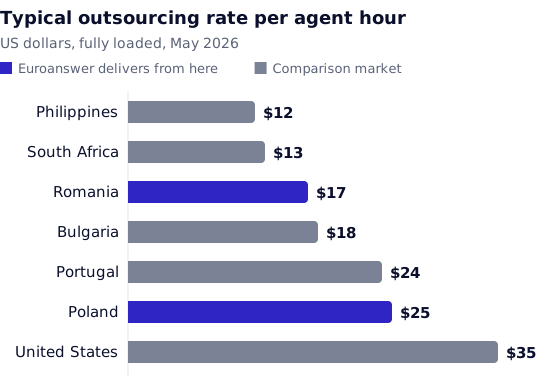
| Country | Typical per hour | Vendor range per hour | Per agent, per month |
|---|---|---|---|
| Philippines | $12 | $8–15 | $1,920 |
| South Africa | $13 | $9–17 | $2,080 |
| Romania | $17 | $12–22 | $2,720 |
| Bulgaria | $18 | $12–22 | $2,880 |
| Portugal | $24 | $20–28 | $3,840 |
| Poland | $25 | $18–32 | $4,000 |
| United States | $35 | $28–42 | $5,600 |
Other published figures differ. Text.com quotes $20–30 an hour for nearshore work, while DesignRush puts nearshore and onshore agents at $3,000–8,000 a month. We would not treat that spread as a flaw in the data. It simply shows that a rate means little until the scope is written down.
Three ways providers charge
| Model | Public price range | Suits you when | Check this |
|---|---|---|---|
| Per hour | $8–60 | Volumes move and you want to pay for time used | Whether you pay for logged-in time or productive time |
| Per agent, per month | $1,200–8,000 | Volumes are steady and the team needs deep product knowledge | Minimum seats and notice periods |
| Per ticket | $1–5 simple, $5–15 technical | Requests are simple and easy to count | How “resolved” is defined, and who decides |
Ranges from Text.com and DesignRush, both 2026. Hourly and monthly figures cover offshore to onshore delivery.
Our own view is fairly plain. If your volume is steady and your product takes weeks to learn, dedicated agents usually give you the best quality for the money. Per-ticket pricing looks tidy, but it needs a clear definition of a resolved case. Without one, the incentive is to close tickets, not to solve problems.
Work out your own budget
You need only four numbers. Here is an example for 10,000 voice contacts a month, at 6.5 minutes each.
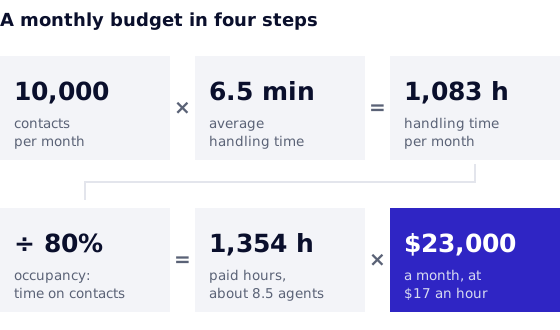
That works out at about 8.5 full-time agents and roughly $2.30 per contact. Across the Romanian vendor range, the same workload comes to about $16,250–29,800 a month. You can run your own numbers in our outsourcing cost calculator.
What really moves the price
Opening hours
One seat staffed around the clock needs about 730 hours a month, against 173 for business hours. So 24/7 cover can quadruple the cost of a single position before a single extra customer calls.
It pays off when volume keeps those hours busy. For a North American personal advertising platform, our team of 10 specialists provides 24/7 support and handles about 35,000 tickets a month, at around 2 minutes each. That is close to 1,170 hours of handling time. At 3,000 tickets a month, the same round-the-clock cover would look very different per ticket.
Languages
Each language needs its own cover, however small the market. That is why small volumes in many languages cost more per contact than large volumes in one. Text.com estimates that adding languages can raise prices by 20–40%.
For the British Council, 13 dedicated agents answer customers from 8 European countries in 3 languages. Scope like this is planned around countries and languages first, then volume.
Channel and complexity
These are the rethinkCX figures for Romania. Phone costs more than email, and specialist knowledge costs more than either.
| Work type | Typical per hour |
|---|---|
| Back office | $12.75 |
| $13.60 | |
| Chat | $14.45 |
| Voice, tier 1 | $17.00 |
| Tier 2 technical support | $23.12 |
| Tier 3 expert support | $34.00 |
Handling time
This is the lever people forget. On one education programme, better quality data took average handling time from 8:53 to 7:34. That is 79 seconds per contact.
Apply those 79 seconds to our example of 10,000 contacts, and you save about 274 paid hours, or roughly $4,660 a month at $17 an hour. An hourly rate $1 lower would save about $1,350. Comparing hourly rates alone can point you to the wrong provider.

Costs that do not appear in the hourly rate
Published figures for these items come mostly from vendors, so use them to prepare your questions, not as a price list.
| Cost | Published estimate | Question to ask |
|---|---|---|
| Setup and onboarding | $500–2,000, more for complex projects | What is included, and is training billed separately? |
| Quality and reporting | 5–10% of total cost | Is QA in the rate, and how many interactions are reviewed? |
| Peak or extra capacity | 1.5–2× the hourly rate | How much notice do you need, and at what price? |
| Minimum commitment | From about $1,000–3,000 a month | What happens if volumes fall? |
Sources: Text.com and DesignRush. Night and weekend premiums and third-party licences may also be charged separately.
Where AI fits in the budget
Expecting AI to remove most of the bill is still optimistic. A Gartner survey of 321 customer service leaders found that only 20% had reduced agent headcount because of AI, while 85% were adding new responsibilities to frontline roles. Gartner also predicts that over half of customer service organisations will double their technology spend by 2028.
In our experience, AI moves money around first. On the education programme above, analysing every interaction cut QA workload by 40%, and that time went into coaching instead of being removed from the budget. If you serve EU customers, also note that chatbots and voice assistants have had to tell people they are talking to an AI since 2 August 2026, unless that is obvious from the circumstances.
Before you sign
- Ask for the same scope, priced the same way, from every provider.
- Ask what counts as a billable hour.
- Get peak and night premiums in writing.
- Agree on who pays for tools and licences.
- Check the exit terms and notice period.
- Start with a pilot in one language or market.
If you are also weighing up regions, read our guide to nearshore customer service in Europe. And if you want a proposal for your own scope, our customer service outsourcing team can prepare one.